I crept down the hill, small white stones shifting gently under the rubber soles of my sneakers. The air was so still I imagined a low murmur greeted my ears from far off, but no one was speaking. The sound of a billion souls, still and waiting. I descended the hillside in a cocoon of silence and rounded the bend where a group of people appeared, standing like ghosts on the hillside.
They gathered in small circles and sat in Adirondack chairs while still more hung back behind, utterly absorbed, and staring out at the mountain range which lay before them, also waiting, like it had each day for approximately one billion years, for the sun to rise.
Transfixed, an interloper with my cigarette in hand, I stooped to put it out on the bottom of my sneaker. Pocketing it, I squatted on the hillside 100 yards away, having arrived too late to intrude on this group of primate wanderers, exposed and vulnerable, the beauty of the mountains on their faces.
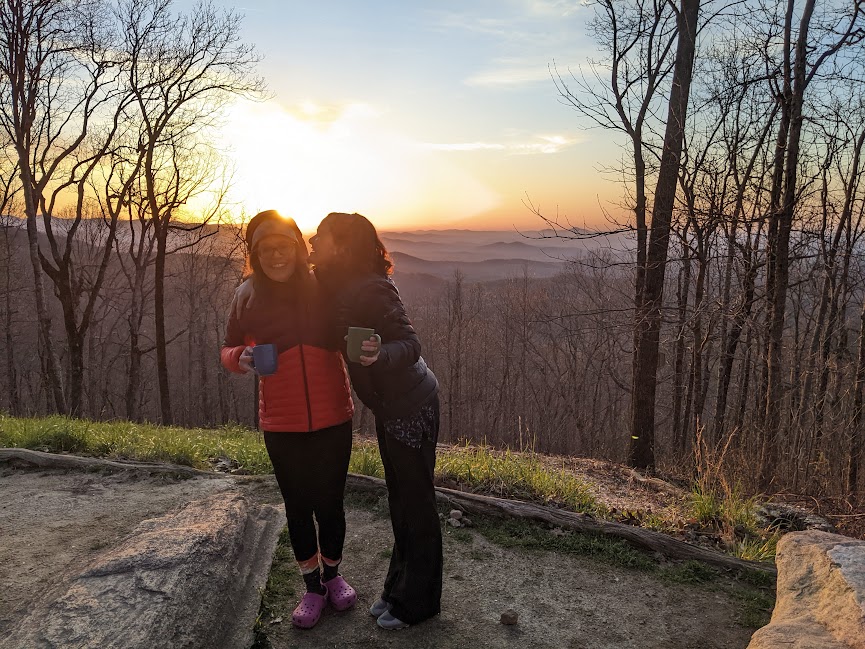
The sun rose on me, on the ancient mountains, the barren and twisting Mountain Laurel, the foraging deer, unseen bears, and on my sister who stood with the dozen or so hikers on the hillside. The sermon of sunrise speaks in such a way that man cannot replicate it by telling. There is nothing to say about it afterwards and no one to say it to.
14.5 billion years ago the sky exploded. There was no sky and no time before it, but afterwards, was everything. And everything was moving, out and out for eight billion more years before a large chunk of rock hit the earth and cut it in two. The moon has since revolved around us, some four and a half billion years or so. Also our home, same material, same rock, not enough gravity to make atmosphere stay put, but enough to pull on our oceans making them churn and slosh against the shores.
And more slow collisions as land masses rammed each other, pushing up one of the earliest mountain ranges that still exists on earth. Higher than the Himalayas are today, the Central Pangean Mountains were one entity. Forcibly separated by more twisting, churning, crumbling, the conjoined siblings were torn apart leaving the Appalachian on the east side of North America, the Anti-Atlas on the west side of Africa, and many more pieces scattered across the globe from Ireland to the Iberian Peninsula.
The sister mountains couldn’t hold onto each other tightly enough, but someday they’ll find each other again. Will they recognize each other in the longing they have felt for a billion years?
Leaving the Len Foote Hike Inn was the first of many instances where we would say goodbye to folks we’d only just met and had no reasonable expectation of seeing again in our lifetimes. People we’d shared food with and laughed with, our journeys intersecting for a few moments in time.
We set off after sharing the sunrise and coffee, the southern terminus of the Appalachian Trail now four and a half miles away.
We started each morning half-asleep rising up hillsides through cool mountain air, slowly waking to find ourselves wandering through dense forest. My legs seemed stronger today, and the short ascent back out to the trail was over quickly.
We passed our Mountain Laurel friends, the periwinkles, and more ramps, but weren’t entirely awake for most of it. About a half mile or so in, we proceeded with what was becoming our customary pause to remove layers of clothing.
Soon, a steep descent found us approaching Nimblewill Gap, named for Nimblewill Nomad. At 83, he completed the trail for the third time becoming the oldest person to through-hike the Appalachian Trail. We stepped off Frosty Mountain and into the breezeway before Springer.
We had never encountered a gap like this one. While other trails had led us winding between mountains, we had never crossed right over a peak, walked straight down a mountain, and walked right back up again as this trail now called for us to do. But first, we gathered ourselves and sat in the gap, wind rushing over our damp and chilled arms.
A plane had crashed here in 1968, the wreckage removed in 1996, and we had heard that the crash site was still easy to locate. We couldn’t immediately discern any remnants of a plane crash, and the reason for this dawned on us slowly.
We couldn’t find it because we were sitting in it. A 100-yard swath of pale dirt where no trees had grown, a scar which still showed 54 years later. Bald and sandy, it did not seem especially out of place except for the irreconcilable fact that it lay between these two lush mountains filled with skeleton trees and towering pines.
As so many before us had, we thought of Richard Fowler Shoolbred, Sr., who had perished here with three others so many years ago. I couldn’t fathom that passage of time; those 54 years must seem immense and instantaneous all at once to those who knew him. And here, where a plaque remembered him, endless time had passed underneath in the building, and subsequent wearing down, of these mountains.
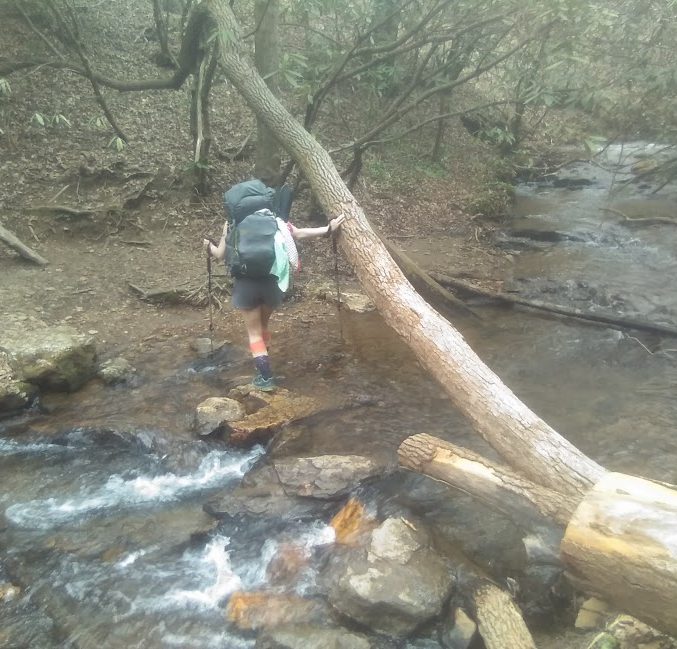
We left the windy gap, our sneakers clinging to the damp hillside as we began the steep ascent up the bottom of Springer. Part of the way up, we approached a great mossy tree trunk, fallen years prior, where another hiker sat sipping her water.
We paused to chat with her, relieved to slide our packs off our sweaty backs for a few minutes. Walkie climbed aboard the massive horizontal trunk and sat next to Myrtle the Turtle, so named during her earlier, slower hiking years, while I contemplated the stream trickling down the hillside.
For our entire hike so far, we had only gathered water from urban sources, bathrooms, campsite faucets, the Inn, but for the first time on this trail, I picked my way slowly to this natural water source and knelt beside the stream. The water so clear I wondered whether we even needed to filter it at all, I stuck the nose of my bottle under the natural spigot spilling over rocks.
I filled my bottle and set it down in the leaves beside me. Then held Walkie’s two-liter water pouch so that its mouth swallowed up the pristine trickle of mountain water.
Myrtle the Turtle was heading North. As she gathered her things and then, strode up the hillside, we sat with the soles of our sneakers tucked up in front of us on the tree.
“What has surprised you the most so far?” I asked Walkie as she squeezed her water pouch through a filter into her bottle.
My sister looked off thinking and said finally “I don’t think I have an answer to that yet.” And then, “what about you?”
“I don’t know,” I said, “Everything.” I had a habit of asking my sister how she was feeling and what she was thinking only because I enjoyed chattering for chattering’s sake. I hoped she would suggest some new topic as I found my mind completely absorbed by trees, dirt, water, steps. The woods reverted my mind to a present tense state that only accepted all that was coming in without contemplating it.
“I feel like we’ve been in the woods a long time already,” she finally offered.
I agreed. I was already losing track of how many days we had been hiking. “I guess I’m surprised by how much we’ve already done that I really wasn’t sure I could do,” I told her.
I felt elated by the fact that the uphill climbs today hadn’t beaten me in any way yet. Rather than winded and tired, I felt energized and powerful. Rather than sweaty and dirty, I felt clean.
On previous hikes with my sister, I had wondered when I would start smelling my own stink. And I had found before, as now, that I only smelled more and more like a tree, like the dirt, like the forest. And I thought maybe that was just the smell of all living things and found it fitting that we smelled like the trees, our distant cousins.
Nordic oral traditions said that God made man out of trees rather than clay. It made sense that your surroundings would shape your image of God, so that folks in the cradle of civilization assumed God made man out of clay, maybe the clay of the Nile River itself.
But my sister and my ancestors, who’d lived on the edge of the Black Forest of Baden, who had invented tree worship in the form of dragging one inside every winter solstice, those Western Europeans in our blood, knew the omnipresence of the dark forest, its mystery and danger. Of course, such flawed creatures as we had been carved out of something so lovely and ominous.
I used to have recurring dreams of a “world tree,” before I found out that this archetype existed long before I dreamt it. It was a really simple dream, but it echoed on and on, a dream of being up in the branches, sensing but not seeing anyone there with me. Many anyones. All the people who had ever lived were up there swaying in the branches. Quiet, watching. I think that’s where I will go, and watch endless time go by.
When we were growing up, our mother would say she wanted to come back as a bird in her next life, and maybe she will build a nest in the branches.
After our break, the trail turned flatter for some time, meandering with little elevation, even dipping into a small meadow where there was a shelter and privy. Black Gap Shelter, our first. Enamored with it, we stopped and left messages in the logbook before beginning our final ascent up Springer, this one adorned with switchbacks.
While I knew switchbacks were a hiker’s friend, built into the trail to ease steeper climbs, I was beginning to abhor them. They were tricksy, keeping the real ascent out of view just long enough to make you believe the mountaintop was nearby. Then, sweeping back again to lure you onwards just a little further. I much preferred a straight fight up and over the mountain; the switchbacks were only flattering and baiting us.
“This is an awful lot of uphill,” I said to my sister, thinking of those long stretches of woods we’d traipsed through so often.
She turned to stare at me, “Myrt, that was the Foothills Trail. This is the Appalachian Trail.”
I stared at her as the impact of her words sunk in. “It’s a mountain range,” she added.
We heard a call from above and looked up the hillside. Two hikers, from the night before, were on their way back down the mountain to stay another night at the Inn.
“The magic sisters!” They cried out upon seeing us. It was the first time we were greeted as a unit, and later I asked my sister “did you hear them call us ‘the magic sisters?’”
Walkie looked over at me and paused. She gently suggested they’d actually said, “there’s trail magic up ahead, sisters!” The hikers, she further elaborated, had left some treats a mile or so past the summit, at the Springer Mountain Shelter.
My dazed hiker brain seemed to have missed some of our brief interaction, leaving me puzzled.
As more hikers passed us heading south, I announced that there was trail magic a little further back at the summit in case they wanted to go and get a treat. My sister smiled at them and clarified “it’s at the shelter about a mile past the summit.” I was thankful the hikers had only passed us with bewildered expressions and not turned around and hiked back.
“I’m going to tell the next group there’s a vending machine just up ahead,” I told Walkie. Then, I thought of ice-cold Coca-Cola, condensation dripping down aluminum, the snap and fizz of a newly opened can. It would be three days of hiking before I could have a soda at the hostel where we would be staying on Wednesday.
I spent the rest of the climb to the top dreaming of what we would eat when we reached the summit.
 Rocks & Roots
I’m so enjoying this hike along with you! I’m looking forward to each chapter!
LikeLike
Oh my gosh, thank you! There are more coming. I wrote the whole thing a ways back and tried to find a literary agent to no avail. So, I’m just uploading it piece by piece. Thank you, Aunt Shelley!
LikeLike