Dawn found me sipping my coffee at the picnic table listening to my sister’s rustling in the tent. First, a squeak of sleeping pad and soft murmuring, followed by silence. A few minutes later, a sigh as she turned over again.
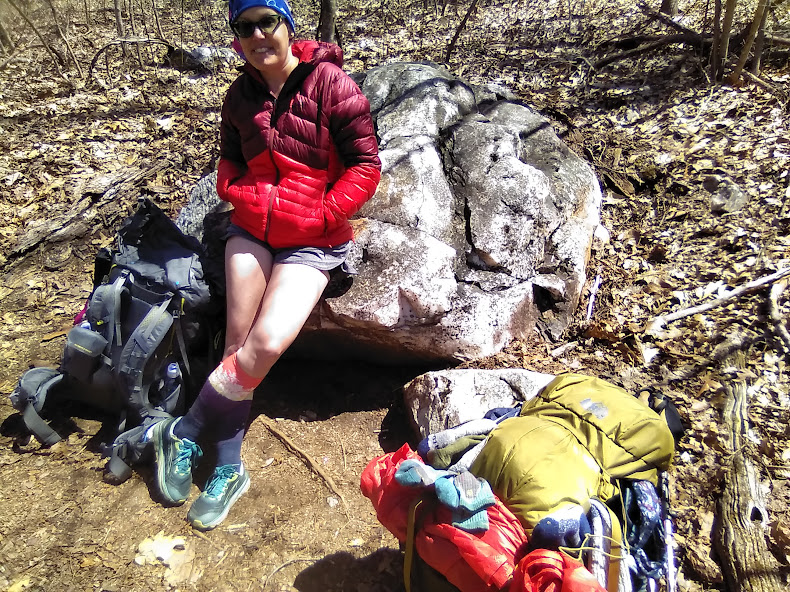
Our morning chores were many and hard to keep track of at first. Taping toes and heels to avoid blisters, boiling water for coffee, hanging dirty clothing on the outside of our packs to air out in the sunlight as we walked, and breaking down the tent.
Organization was key, striding back and forth across the campsite looking for the bathroom kit which held hand sanitizer; or the first aid kit with a small assortment of medicines, Band-Aids, and tape for our feet; remembering to bring the filtered water with us, as well as a clean bandanna for drying our faces after brushing teeth.
Back at home, I could wander sleepily through the house and find my waking-self had already set everything up for me. Towels where they needed to be, hair products in the same drawer. While backpacking, everything you need is one place, but seemingly nothing is in a convenient location, so small things, like boiling water, take some amount of planning.
I was carrying three bandannas, for instance. One to keep my hair covered and prevent sweat from dripping down my forehead, the second worn around my neck to wipe my perpetually dripping nose, the third for cleaning up utensils used for eating and drinking. This last one would be tied around a tree trunk far from the tent at night to dry in the night air and serve as a precautionary measure against any bears who might get a whiff of our dinner and come to investigate.
Each item we carried could be washed in a stream and hung on the outside of a pack to dry in the sun while hiking, but it was of utmost importance that we did not mix them up—cleaning our eating utensils with my nose rag or wiping my face with remnants of our rehydrated dinners.
Breath drifting like fog, I ambled about the campsite, sipping the coffee I so artfully garnered via my solo night hike to the lodge.
I heard a bit of hushed whispering from the tent; my sister was bouncing ideas off herself as she stirred, perhaps reviewing our steps up the waterfall the day before, perhaps thinking aloud about the day ahead.
Her self-talk soothed her, helped her remember details and sort through her thoughts. Satisfied that she was waking up, I sat at the picnic table, staring down at my notebook filled with all of mine.
I lay my phone, trekking poles, and water bottle next to me on the table—the most likely things to be left behind in our morning stupor.
A treasured walking stick accompanied my trekking poles, hand-carved by Walkie’s father-in-law, who had perhaps dreamed more of our being out here together than we ourselves had. A true outdoorsman, his property had been deemed a nature-preserve due to his dutiful accounting of the many species of animals whose visitation he had encouraged and nurtured throughout the years.
“Lose yourself in nature and find peace” he had gently etched into the piece of polished Dogwood capped by a handle of glistening California Redwood.
Walkie emerged and sleep-walked towards me, and I stood to greet her with a cup of coffee from the lodge, its content long cooled.
“I had an adventure last night,” I told her smiling.
“I see that,” she said taking the coffee and enjoying it, lukewarm though it was. Our packs lay propped against the pale pine planks of the table as we sipped and stared off.
Not surprising, she hadn’t slept well despite the sacrifice of my warm sleeping bag. This was always our experience on first nights of camping, and I hadn’t expected much better for our night in the freezing weather. Still, the rest of the week would be warmer, and we would become reaccustomed to sleeping on the ground with each consecutive day we spent in the woods.
I began my customary morning chatter, peppering Walkie with questions and commentary, while she stared off accepting my incessant monologue; her countenance striking me as being much like our father’s, who was also slow to talk first thing in the morning.
“You know what? You’re dad and I’m mom,” I told her. She looked up and smiled, knowing as I did that had our mother been with us in the woods, we would both have been merrily relaying all our thoughts. Walkie continued zoning out, while I continued telling her about my night hike, and about the long map of the Appalachian Trail from the Lodge and how I’d wondered if we couldn’t just keep walking to Mount Katahdin. I was probably interrupting her internal planning of our day.
We’d been raised on the Beatles and baseball by Yankees in the foothills of South Carolina, so it was no wonder our family had turned out a minister, a teacher, a writer, an accountant, and an actress; our parents wanted us to grow up to be good humans and hadn’t mucked up their messaging with too much instruction.
“Am I talking too much?” I said after turning over and examining every leaf and stone in my arsenal of thoughts.
She smiled and said, “you can talk all you want, as long as I don’t have to answer.” And sipped her coffee.
A few minutes later, she paused to peer over her paper coffee cup at me, “We probably shouldn’t wake each other up if we’re already asleep. I think you woke me up last night to tell me you weren’t a bear.”
I was silent for a few moments as I took in this assessment.
“To be fair, you woke me up first to make sure I wasn’t dead,” I told her.
We did our morning yoga and agreed that I was neither a bear nor dead, and we shouldn’t wake each other if one of us had finally gained a foothold on sleep, so hard to come by in the woods.
We set out from the campsite that morning to hike beside each other into the wilderness, everything that lay before us unknown, a mass improvisation that mainly consisted of walking, eating, looking for water sources, walking more, and setting up camp again. Although that evening, at least, we could look forward to a warm night indoors out of the weather, as we would be staying at the Len Foote Hike Inn, a charming respite located 5.3 miles away.
My sister calculated that it would take us a little under five hours to get to the inn at our current hiking pace and with a lunch break built in. The Hike Inn would find us at a half-way point on the approach trail leading to the summit of Springer Mountain—the official beginning of the Appalachian Trail.
We gathered our trekking poles and beloved walking stick, and started out taking turns leading the way, until finally, we reached the steep ascent of the approach trail, at which point I let Walkie get in front.
She was stronger on the uphills and didn’t need to stop as often as I did. Watching the heels of her grimy sneakers gave me something to concentrate on. Walkie trusted her body, often looking up and around her, enjoying the landscape, while I stared down at the trail, at dirt and rocks and roots, and felt my heart pounding with effort. I hoped there would be a time when I could look up while I hiked, but for now, it was one painstaking step at a time.
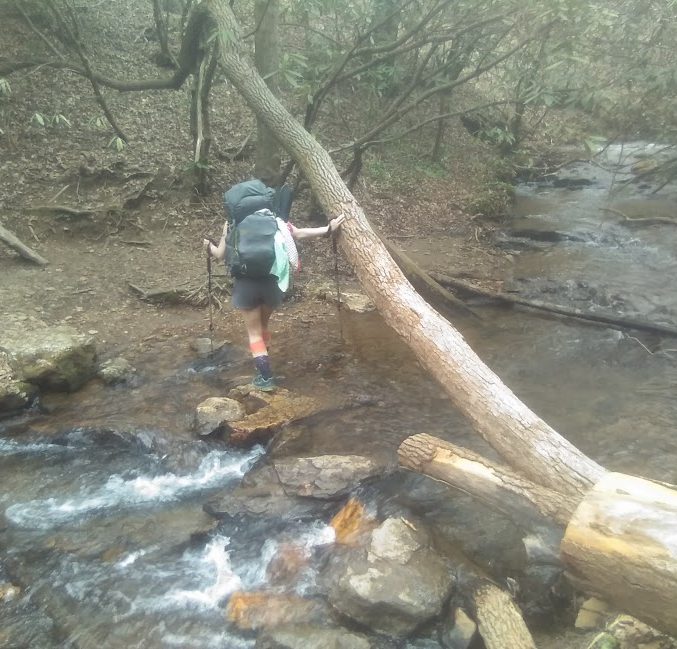
While my sister slopped right through the puddles left over from the snow as well as the many April rains before it, I avoided them. I abhorred having water squelching between my toes.
I navigated the trail in nearly the opposite style of her, taking advantage of dry rocks and slick roots over which I could cross small puddles and keep my feet dry, and my sister christened her sneakers in the mud of Appalachia, wearing those clinging clumps as badges of honor. Those shoes had lived a million lives already, having seen my sister through miles of running. They were her trusted, though weary companions.
We chatted continually as we walked, me hovering a bit too close behind her always, sometimes stepping on the backs of her feet. Though I was the older sister, our roles had reversed over our years of growing into ourselves. Typically, my sister was the planner, the one who showed up on time and who had an innate sense of direction.
I was the late bloomer, am still busy blooming. Most of my petals had long since fallen and lay wilted on the ground around me, but I was always trying in earnest to get myself together. I was more comfortable following her into this journey than leading, and in fact, would never have begun it on my own. I lived my life immersed in satisfied dreaming, loved exploring ideas and watching, content to stand back and observe. We had some things in common though, too. Each noted by others as being extraordinarily stubborn, and silly. We laughed more at our own jokes than others did and created our own fun.
Our hiking style was the same—joyful, chatting and singing continually. Our talking served many functions, passing the time, but also letting animals know we were about. When we ran out of things to say or exhausted a topic, our chatter devolved to random noises.
On other trails, we had improvised a song, and once or twice a day, we would resort to passing the tune back and forth:
Onomatopoeia Sisters,
Onomatopoeia Sisters, Unite!
“Whack!” “Ka-Pow!” “Ooga booga.” “Ding dong!”
The Onomatopoeia Sisters,
The Onomatopoeia Sisters,
What are we gonna do today?
We’re walking on the approach trail;
Walking uphill to no avail.
Are we getting closer? We just go,
But when we get there we will know. Take it, Myrt!
Onomatopoeia Sisters,
Onomatopoeia Sisters,
I thought those Amicalola steps were hard,
But we did it; we’re strong and in charge.
We’ll be at the Hike Inn tonight,
And when we get there, we’ll be alright.
Onomatopoeia Sisters,
Onomatopoeia Sisters,
“Wonk!” “Meow!” “Moo.” “Pow!”
Onomatopoeia Sisters, UNITE!
The tune was catchy, the words less so, depending on our level of exhaustion or inspiration—in direct correlation to how many miles we had come, how hot the sun was on our backs, and how much further we had to walk. Often, Walkie started in with the song just exactly when hours of hiking in the afternoon sun found me too grumpy to sing.
“Here we go,” I would think to myself, but end up busting rhymes and skipping along. Any bears, possibly other hikers, were wary of us.
Fallen leaves gleamed like caramel that morning. I appreciated that crunch under my feet more than the incessantly well-groomed yards of suburbia, and these woods boasted crooks and crannies piled up with leaves where no mechanization had stirred them from the natural process of decay and rejuvenation.
The fisherman had been right. The approach trail was hard. I had to stop much more often than my sister just to breathe. Uphill and more uphill, I started worrying my smoking had weakened my heart through years of indulgence. I hoped I didn’t keel over out here. When you’ve done something to yourself that you can’t seem to stop doing, it’s hard to come to terms with the consequences, but I could not explain away the trouble I was having.
We continued all day, noticing how often the woods changed. Checking in with each other “How are you doing?” “How are your feet?” “Anything hurting?” With just a mile or so of walking, the woods could change entirely, flat areas with spindly trees turning to hillsides filled with Rhododendrons.
Sometimes there were tall woody plants whose branches twisted and turned in beautiful tornados. We wondered what those were—they had no leaves or blooms as spring had not reached these heights in Georgia. Spring moves up mountain sides slowly, and we had left it far below with our winding ride up Highway 17 the day before.
“Only the day before?” I wondered. We hadn’t even spent a full day out here yet, but it seemed we’d done at least three or four days of living already.
Where we were, winter still ruled, and things were sleeping. Here were only small green plants which Walkie identified as ramps—a relative of onions, and edible—as well as patches of periwinkle.
“Which parts are we supposed to eat?” I asked her.
“All of them. Every part is edible, like a scallion,” Walkie told me, pointing out the ample gatherings of ramps beside the trail when we came upon them.
At that very same moment, someone in a car was passing on an unseen highway. Someone who had climbed into their car just a few minutes ago, traversed the same distance we had come, and who had not seen the woods change a dozen times during their travel. We were living in slow motion, every breeze felt across the tips of our ears, every unexpected meadow that lay behind a bend, noted. Every drip of sweat sliding between our shoulder blades felt.
Hours passed, and we climbed Frosty Mountain, reaching the turn-off to the Inn where the trail led us comfortably down, down, down into a valley.
“Thank you, trail,” I said quietly, and my sister repeated “thank you, trail.”
I was happy for the reprieve from sweating uphill, but worried about beginning tomorrow with a steep incline back out to the trail. There, in the middle of the woods, appeared the beautiful lodge comprised of four or five buildings all strung together with wooden staircases, walkways, and balconies. The Len Foote Hike Inn.
We could also see Springer Mountain now, clear as day. The scale of mountains is so very large that it is hard to fathom in a realistic way. That mountain which lay just in front of us, which we would hike tomorrow—we would look like ants climbing it. Ants hidden under tall gray-green pines. It looked like it should take a hiker at least two days to climb it. With nothing so large from our real lives to compare it to, Springer Mountain rose into the clouds, and would only require a few hours for us to summit it tomorrow.
 Rocks & Roots