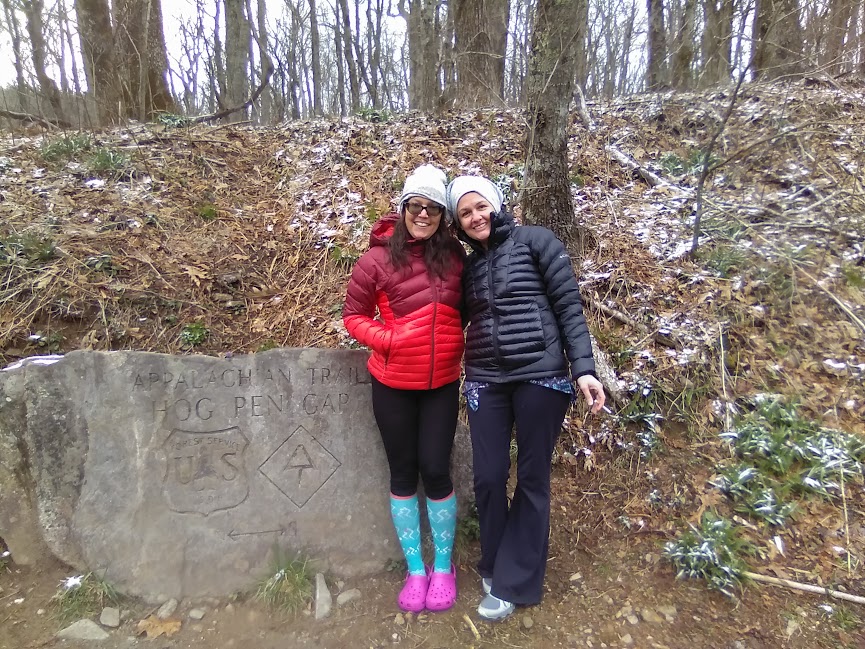
We left Hogpen Gap together, and during our ride down more narrow roads, Walkie said “I love the snow, I just hope it doesn’t get below freezing tonight.”
“I know,” I chewed on my bottom lip. “I hope I’m not dragging us into a terrible night, I just hate to keep putting it off.”
34° was the lowest we’d ever camped in, and it had been miserable. I had slept for only a few minutes at a time. In the night, I dreamed my son’s father offered me a sweater and built us a warm fire, after which I woke up shivering again. But while I shared Walkie’s worry about the cold, I knew we would survive it, likely in much discomfort, the rest of the week promising temps of above 40°.
We arrived a little while later at Amicalola Falls State Park, where we would abandon my car for the next eight days. Inside the visitors’ center, my sister led us through registration for hiking the Appalachian Trail. We checked one thing after another off our list of necessary preoccupations—our actual occupation being getting started on those steps as soon as possible.
Walkie Talkie’s pack weighed in at 18.2 pounds that morning, and mine at 24. She was carrying our tent, poles, and stakes, while my pack bore our bear canister filled with instant coffee, dry-packed dinners, pepperonis, burritos, beef jerky, pistachios, golden raisins, and a slew of other treats, which I knew based on previous trips, would only become more delectable as they dwindled over the coming days.
While packing our food rations the evening before, we anticipated actually being in the woods together by making a sample plate of our hiker treats and devouring them as we continued discarding, sorting, and weighing items that might be added to our packs.
Most hikers need about a pound and a half of food per day, and our shared canister was filled to the brim. It needed to last us until at least Wednesday, four days from now, when we would arrive at the Above the Clouds Hostel after climbing Sassafras Mountain.
We filled our bottles one last time at the spigot out back behind the center, and began our morning yoga in the grass, stretching our calves and ankles.
“What are you most excited about?” Walkie asked me. “I’m not sure,” I answered. “The woods, I guess,” I laughed, “Everything about the woods.”
I didn’t have enough experience to know what to be excited about. The deepest my sister and I had ever found ourselves in the woods had been eight miles in on a Sunday when all the weekend campers had gone home. The woods had been much too quiet that night, and I’d felt our isolation keenly as I waited for sunrise.
Prickly pine needles pressed into my palms, our heads hanging low, in “downward dog.” “I’m curious to see how many people are on the trail with us,” my sister said. “Yeah, I’m wondering about that, too.” I answered, hoping there would be few.
My mind was filled with anxiety about the incoming tide of steps and sweating, as well as fear about whether I could keep up with my sister. My soul wasn’t settled enough for human interaction, outside of the comfort her steady presence.
People milled about the park that morning, some of them families picnicking at pine tables, some of them hikers like us, some of them carrying huge packs that that threatened to engulf them. I was thankful that my sister, now squatting next to me in the grass, had skimmed six whole pounds off my pack when she saw all the unnecessary stuff I’d planned on bringing.
“You pack your fears,” she told me when she’d dumped the contents of my bag out onto the floor of my living room, “Your fear is cold.” She’d read my precious junk like a spread of tarot cards, a hiking fortune-teller.
Man, I hated being cold. I could hike through rain, survive on coffee alone if we ran short of food, keep myself occupied with my thoughts for hours. Staring at looming skeleton trees harboring a meadow of silence, would entertain me, but I didn’t have the mental stamina required by cold.
I couldn’t lay in my bag, shoving my hands into my coat pockets, pulling my knees up to my chest, adding another pair of socks in vain. I would rather get up and start hiking again then lay down freezing, waiting for morning to come.
It was why I’d opted for a heavier sleeping bag, synthetic, not down. While down is the warmer material, it was also lighter and didn’t weigh on me heavily and snuggly like my synthetic bag. It weighed two pounds more and was bulkier than my sister’s, but it made me feel enveloped. Safe. Initially, I’d also packed five pairs of socks, two long-sleeved shirts, and two hats, among many other instances where I’d doubled the number of the layers my sister promised me, I actually needed.
Some of the hikers ambling about that morning were carrying what they feared, fending off worries of hunger, loneliness, and boredom, or like me, the cold. The main indulgence I would not be rid of was my pen along with two moleskin notebooks. If I couldn’t write my thoughts down while drinking stale instant coffee and smoking on a tree trunk, I might as well stay home.
Something old, something new, something borrowed, something blue, and your puffy jacket is pretty much what you need to hike the Appalachian Trail, because you’re going in blind anyway, and saying “I do” to the mountains until you figure them out and figure yourself out. Then, you can throw yourself a tent-warming party or something when you reach Neel Gap. Or get an annulment, as many hikers do, leaving their boots and sneakers dangling in the treetop outside of Mountain Crossings.
The previous owners of those smelly birdhouses had conquered Blood Mountain, fulfilled whatever curiosity had led them here, challenged by the woods, the mountains, and their internal thoughts. By the time my sister and I reached there, some 45 miles away, we would nearly be finished with our first section of the trail. While so many hikers abandoned the trail there in Neel’s Gap, many more would continue on, crossing into North Carolina and entering the Smoky Mountains beyond.
As we leaned over our outstretched legs, one of my hiking dreams came spilling out, “I hope we get to night hike at some point.”
While planning our itinerary, we’d allowed ourselves some dreamy goals, small experiences we hoped to gain during this first leg of our journey. Sleeping in a shelter, staying at a hostel, indulging in trail magic, and possibly, a night hike, venturing into the dark forest with our headlamps lighting the way. We also set a mileage goal, that we might attempt were things going better than planned—a twelve-mile day.
Hoisting our packs on and yanking down the side straps one more time, we approached the falls, me staring down at my sneakers, placing one in front of the other along the paved pathway leading to that immense crystalline cascade of rock and water, bounded on all sides by steps leading all the way up.
Dangerous doubts seeped into my soul when my sister pointed upwards to the falls. She was shining with optimism. They were terrifying to behold, gorgeous, vertical. I almost started crying, on the flipping pavement before we’d done anything yet and dabbed at my eyes with the bandanna tied around my neck.
Just then, a fisherman standing in the pool at the bottom of the falls, waved us over. In his waders, he swung his fly-fishing rod back and forth across the pond.
“Where are you two headed today?” He asked. He was breaking my nervous momentum, but I was relieved to stop thinking about the 604 steps for just a minute or so.
“Hogpen Gap.” My sister told him.
“Oh, that’s a long way from here,” he smiled.
“We’re only doing the falls today,” I told him. “We’re hoping to get to Hogpen in a few days.”
“Hmmph,” he grunted, satisfied with that plan. “The approach trail was the hardest part of Georgia,” he continued, “when I hiked it a few years back…if you can do the approach trail, you can hike the whole thing.”
Everybody knew about the sharp rocks of Pennsylvania, the feared whites of New Hampshire, and of course, Blood Mountain, its looming nearness haunting my psyche, but I’d never heard anyone complain about the approach trail before, and I was not encouraged.
We trudged onwards, the falls growing closer with each step. We left the fisherman more to the art of fishing then of catching anything if Norman Maclean and David James Duncan are to be believed.
I was an admirer of this intrinsic approach to things, only the means. So many times in this life people seemed to be asking what was next, what was up ahead. I always had trouble putting my thoughts very far into the future. I was content to let the future take care of itself as I was always fairly busy juggling the present.
We arrived finally, standing for just a moment at the bottom of the 604 steps up the falls, and then, went up. Up and up, I paused at each consecutive landing to sweat and breathe, and lay my head down on the wooden railing. Walkie patiently broke her own momentum each time to wait with me.
I wanted to “embrace the suck,” as my sister long ago shared this useful hiking trope which aptly expressed that sometimes the woods don’t match up with story-time visions of serene landscapes rolling by. All those vistas, river crossings, and wandering through flatter areas under tunnels of towering trees; they had to be balanced by difficulties, and were, in my sister’s accounting, made more rewarding by their existence.
She was an optimist. I was content not to do another hard thing in my whole life. Contrarily, I wanted to face all the obstacles the woods could throw at us, at least in a figurative way, at least in my imagination.
Somewhere up the falls, we reached a landing where someone had graffitied in red marker “Don’t stop, you’re almost to the top.”
“Give up now,” another helpful hiker had written just below.
Families with children and dogs on leashes bounded past us, and I felt grumpy at them. Not their passing us, just their existence. “I think of myself as easy-going and peaceful, but when I’m going uphill, I hate everything” I told my sister. I watched the backs of her toned legs as she stepped and tried to turn my brain off and just follow her.
For a while, I practiced “child’s pose” in my mind—visualizing my bent knees resting underneath me as I lay curled on a yoga mat, the top half of my body swan-dived over with my fingertips touching the floor out in front of me. On the inside I achieved some moments of restfulness, tricking my legs for moments at a time that they were not occupied in hauling me further and further up that waterfall.
When I first started practicing yoga, I felt such confusion. Firstly, I didn’t have time for it, secondly, I was far too anxious to just sit with myself, thirdly, I wasn’t sure I was doing it right.
But studies hinted at yoga’s health benefits including lower blood pressure and resting heartbeat, as well as an increase in physical stamina, all of which might result in the lowering the level of anxiety I carried with me my whole life.
I figured everyone felt nervous from time to time, only handling life’s challenges better than I, which only added to my tendency to blame myself. How in the heck had all these folks developed such great coping skills? It left me feeling I just wasn’t trying hard enough.
So, I struggled through those beginning moments of breath before movement. Sitting still on the mat as an instructor asked me to breathe deeply. My shallow breaths were afraid to make the journey all the way to my stomach and fill that space. Feel that space. I would suffer through those first few moments, only waiting for movement, for reaching past and over my fears without acknowledging them.
I spent most days in frenzied movement trying to keep my thoughts at bay. Settling my soul in any way, stillness, quiet, breath, these things were dangerous to my restless mind that wanted to cycle and spin through worries of all kinds, mostly about my own heart.
Could I sit with myself and forgive the failings I found there? Was I allowed that? Even so, I couldn’t afford it. Couldn’t afford to find and name more fears that lurked within.
The woods held the same intense anxiety. So still. So quiet. And so, so big. Expansive with towering trees and space moving outwards away from me. Small me, small mammal, standing still in the woods. Hiking was fine, moving was fine.
It was the in-between moments that were hard for me. The negative space between a forefinger and thumb. Between words hanging in the air. Between my steps as I put one sneaker down in front of the other. I wanted to throw away the space between breath.
The space between my steps was where I was falling. The space between breaths was where I was asphyxiating myself.
With years of practice, I became a yoga evangelist, recommending it to everyone, but I still hated the breathing before and the Savasana afterwards, where you lay on your mat like a corpse and sank into your own body and mind. That was the very farthest thing from what I wanted to do.
My sister and I practiced together every morning and evening in campsites, under tall trees, in pine needles and dirt. Yoga left our muscles ready for the next day, so that where others hobbled in the morning, we were clear-headed, strong-bodied, and ready to bounce down the trail.
Nearly to the top of the falls, the end in sight, my sister turned and cried out “look!,” calling my attention to the view behind us. We paused on the landing to look back over seeming miles of distance. The pond below shrunk to a puddle, the parking lot down below filled with miniature toy cars, and out beyond that, an endless sky.
It was mesmerizing, truly. I didn’t know how we’d gotten so high and so far from the visitors’ center. It looked like a distance that should have taken possibly a whole day of hiking, rather than just over a few hours.
I had a few sorry moments on those steps, when I wanted to raise my sweaty forehead off the landing and turn back, maybe bring it up for discussion, at least. But my sister believed we’d make it to the top. She offered encouragement, checked in to see whether I was pushing myself too hard or needed to stop. She could have climbed the stairs in 45 minutes by herself.
She was right. We’d made it to the top of the falls. I was thankful for her patience with the unceasing doubt I kept poorly hidden. I was so afraid of those stairs and wondered often whether we should skip them altogether, as so many hikers do. I felt elated and enamored with our own strength.
But beyond the top of the steps…there were more steps.
My fleeting mental game was shot as my gaze rose to that mild climb leading us to more business, having to check in at the lodge and claim a campsite that lay another half mile away in the woods. The lodge, at least, boasted a bathroom where we could refill our water, and a lobby where I stepped around the nice furniture in my sweaty clothes hoping whatever stench I had already acquired would stay put and not offend passersby.
In that pristine lobby, a hiker approached, jingling and jangling in his soul, his elbows and hands spread wide.
“Hi, I’m Cap,” he told us. He was a thru-hiker heading all the way “to Maine or bust” he said twice. I listened as he rattled on, which served me fine as I couldn’t string too many thoughts together.
Thankfully, a nearby hiker, reclining an overstuffed chair, rescued me by engaging Cap’s attention. After a few minutes, I overheard when Cap saying jauntily to him “well, if it isn’t too presumptuous of me, I’d like to tag along with you, and take on the trail together.”
It was too presumptuous of him, as 2,194 miles was kind of a long commitment after less than three minutes of chatter, so the other hiker disengaged and retreated upstairs.
My sister and I focused on each other, as Cap hovered about us trying to ascertain whether we were having dinner at the small restaurant off the lobby. I pursued the least amount of encouraging small talk as possible, willing him to move on, and we left him waiting for his own table as we sat down.
I wasn’t interested in adding company to our sister adventure yet, or ever.
Unlike my sister, who seemed to stay open and accepting of life’s offerings as they came along, I was slow-moving, needing time to adjust and weigh and calculate before adding to the heap of sensory information already assaulting my eyes and ears. Life always saying, “here’s another unexpected blessing,” me always responding “thanks, I’ll pass and hope for the next one.”
I wanted to order two or three things just to shut down my mind and stuff my belly with food, rather than feelings. We settled for the soup and salad bar, and a mini bottle of champagne. Our campsite lay half a mile away in the falling temperatures of the frigid wood, but happily, we put off the cold a little longer.
“Cheers to the AT, Myrt,” Walkie said. “Clinky clinky,” I replied smiling.
 Rocks & Roots